
How to Learn AI at Home (Step-by-Step Guide)
- by Sync Life code Team

- April 2, 2026
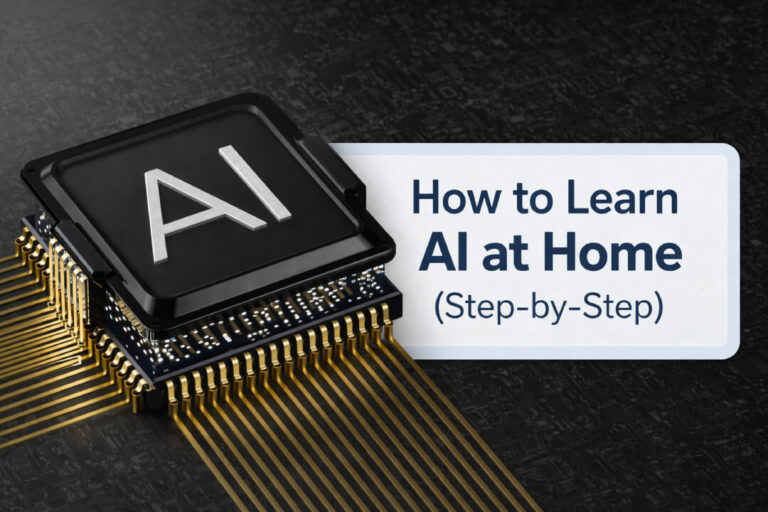
Nowadays, the trend of AI is growing very fast. People are using it to increase their productivity, finish tasks faster, and even improve their decision-making. From a job point of view, almost every tech company now prefers employees who know how to use AI tools effectively. And if you’re from a development background, having AI skills can open the door to high-paying roles because many companies hire people who truly understand how AI works.
So based on this increasing demand, I decided to write this blog for those who want to learn AI at home—in a simple way, without confusion. I personally believe learning AI at home is the best option if you want to save time, save money, and learn at your own speed. So without wasting your time, let’s start this blog.
When anyone starts learning AI, they usually have a few common questions like:
- How to start learning AI for beginners?
- What is the roadmap for an AI engineer?
- What skills are required for AI?
- How to learn AI online or for free?
This blog covers all these doubts in a step-by-step format.
Step 1: Build Strong Programming Basics (Required for Learning AI at Home)
Before learning AI, you need solid programming knowledge. Just like in school we learn subjects to understand the next topics, AI also becomes easier when your basics are clear. At the starting stage, you only need basic computer knowledge and a laptop or PC.
If you’re completely new, start with Python because it’s the most beginner-friendly language for AI. You should learn Python syntax, data types, loops, functions, classes, and then move to libraries like NumPy, Pandas, and Matplotlib.
How I Personally Learned Python
My method was very simple. I first visited w3schools and checked the list of Python topics. Then I picked one topic (for example, variables), searched for that topic on YouTube, and watched tutorials.
Process:
W3Schools topic → Search on YouTube → Watch → Practice → Move to next topic
Following this method, I learned Python in one month.
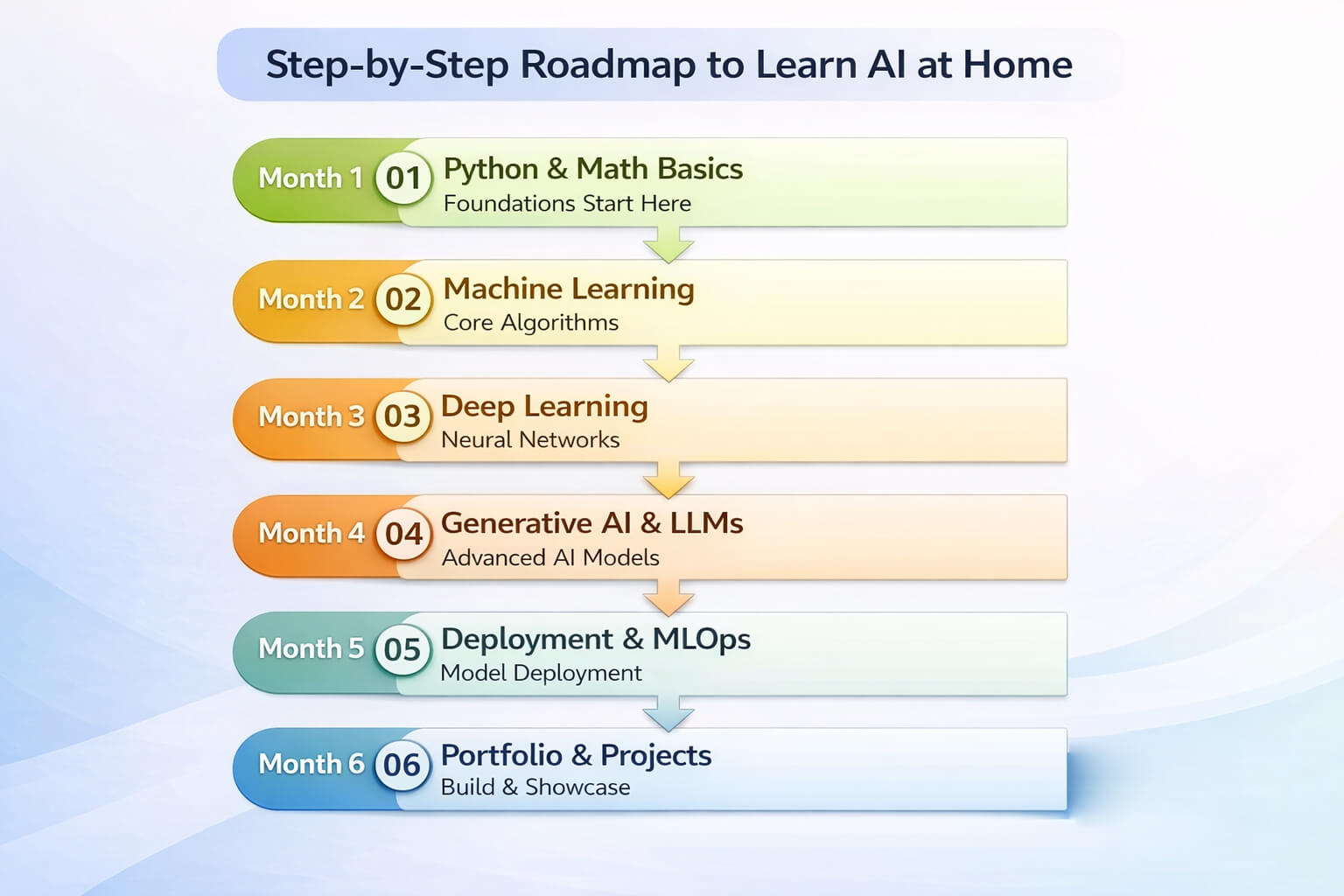
Month 1: Python + Math Basics (Foundation for AI)
To learn AI at home, Month 1 should be focused on:
- Python fundamentals
- Data structures
- Libraries (NumPy, Pandas, Matplotlib)
- Basic math needed for AI: Linear algebra, probability, and statistics
These topics are easy to learn with YouTube tutorials. Even if you spend 1–2 hours daily, one month is enough to build a good foundation.
Month 2: Machine Learning Fundamentals
After Python, the next step in learning AI is understanding Machine Learning. This is the heart of AI. Start with basic algorithms:
- Linear Regression
- Logistic Regression
- Decision Trees
- Random Forests
Learn how to clean datasets, perform EDA (Exploratory Data Analysis), and use scikit-learn.
When I completed Python data structures, I naturally started understanding algorithms, so learning ML became easier.
This month will make you realize why Python and Math are important in AI.
Month 3: Deep Learning & Neural Networks
Once ML is clear, move to Deep Learning, where you’ll understand how neural networks work. Learn about:
- ANN (Artificial Neural Networks)
- CNNs (for images)
- RNNs and Transformers (for text/NLP)
Use frameworks like PyTorch or TensorFlow. These tools help you build neural networks without writing everything from scratch. Spend this month practicing small models to understand the structure.
Month 4: Generative AI & LLMs (Most Trending Skill)
Right now, generative AI is in huge demand. Learn:
- Prompt Engineering
- RAG (Retrieval-Augmented Generation)
- Using APIs like GPT-4 or open-source models
- Working with tools like LangChain or LangGraph
If your goal is to build AI apps, automations, or chatbots, this month will take your skills to the next level.
Month 5: Deployment & MLOps
This is an important month because many people learn AI but don’t know how to deploy their models. Learn how to:
- Use Docker to containerize AI apps
- Create APIs using Flask or FastAPI
- Deploy on cloud platforms (AWS, Azure, GCP)
Once you understand deployment, you’ll be able to build real-world AI projects.
Month 6: Build Your Portfolio (Very Important for Jobs)
To get a job or freelance projects in AI, you must show your work. In this month:
- Build 2–3 complete AI projects
- Deploy them online
- Upload them to GitHub
- Share them on LinkedIn
Some project ideas:
- AI chatbot
- Image classifier
- Text-based question-answering bot
- AI productivity tool
This will help you stand out from other beginners.
Final Words
I hope this blog answered all your doubts about how to learn AI at home, especially if you are a complete beginner. Trust me, learning AI at home is 100% possible, even for free, if you follow the right process. Just stay consistent, learn step-by-step, and build projects.
If you follow this 6-month roadmap properly, you’ll have enough knowledge to start your AI career confidently.
Good luck with your AI journey!
Frequently Asked Questions
1. Can I learn AI at home?
Yes, you can learn AI at home. Many high-quality online courses, books, and free resources make it possible for beginners to study AI without formal classroom training. Consistency and practice are key.
2. Do I need a strong math background to start learning AI?
A basic understanding of math—especially linear algebra, probability, and calculus—is helpful, but you don’t need to master everything before starting. Many beginner-friendly AI courses teach the required math along the way.
3. How long does it take to learn AI?
The timeline varies depending on your pace and goals.
- Beginner-level understanding: 2–3 months
- Build small AI projects: 4–6 months
- Job-ready skills: 9–18 months
Learning AI is a continuous process, so the more you practice, the better you become.
4. What tools do I need to learn AI at home?
Most beginners can start with a basic laptop. Essential tools include:
- Python
- Jupyter Notebook or Google Colab
- Libraries such as NumPy, Pandas, Scikit-Learn, TensorFlow, or PyTorch
Cloud platforms like Google Colab let you train models without expensive hardware.
5. Should I start with AI, machine learning, or deep learning?
Start with machine learning, as it forms the foundation for AI and deep learning.
A recommended sequence is:
- Learn Python
- Learn machine learning basics
- Learn deep learning
- Explore specialized fields like NLP or computer vision